When it comes to early developmental issues and question marks, it's nice to have a friend. God has given me one such friend who has traveled a parallel journey of evaluations and therapies with her oldest son. She's been so kind to listen to me go on and on about whatever my current concern may be. She's been quick to encourage and is to be credited with (but not responsible for!) my thoughts in this post since I do my best thinking "out loud." She's also graciously allowed me the privilege of praying for her son and their family as they've faced decisions and challenges. Our boys are different in some ways and similar in others, as is the case with her and me.* While we've both felt the void of having someone who knows exactly what we're dealing with, it's been encouraging and normalizing to have each other.
One thing we have had in common through the past couple of years has been our feelings and questions--feeling as if everything depends on us, specifically, as the "mom," questions of what's "quirky" and what's truly "a-typical." We've both been on the receiving end of loving encouragement as well as impolitely delivered bad advice. We've struggled to figure out practical logistics with our kiddos as well as spent hours thinking through preschools, therapy centers, and schools--from grade school to beyond.
And all of those school thoughts include so many unknowns and what if's. Receiving appropriate therapies early is so great for little minds that there is really no way to predict outcomes from child to child. This is both encouraging and maddening. You almost just want to know right now what you can reasonably expect from your child in five, ten, and fifteen years. The idea deceptively implies life will be easier or you'll be more "at peace" if you can just know how it's all gonna go here and now.
But, you can't.
And, the more I've read about the instances of dyslexia accompanying apraxia, or the parts of Spencer's speech that may or may not ever sound completely "normal," or the possibility of accompanying fine motor delays, or the common co-morbid sensory processing disorders that may or may not be the underlying cause for the still-too-frequent "emotional outbursts," the more I've thought about the comments we received about the necessary measures for Spencer to be "successful" at communication and, ultimately at school. And, as I mentioned previously, when we decided to keep Spencer at home as opposed to sending him to day treatment, I had occasion to think even harder about the "success" I was supposedly gambling away. And, while talking to my friend, I had a bit of an epiphany of sorts. It's really nothing new or special at all; and, it's good news.
It really doesn't matter if Spencer is exceedingly "successful" at traditional "school-based" disciplines. It's not success for me as a parent or for him as a person if he makes straight A's his whole life. On the contrary, I might be tempted to argue that sort of achievement early on sets you up for quite a bit of heartache later in life. It doesn't really mater to me whether or not he speaks "perfectly" by the time he's ten. My heart won't swell with pride someday because of my son's "success" at sounding "normal."
Don't get me wrong, I want Spencer to have a happy, full life. I want him to work hard for things and to be able to feel the satisfaction of achieving his goals. I don't want school to be hard for him. I don't hope kids make fun of how he sounds in fifth grade. But I won't feel that he or I are living a life of any less "success" if that's the case.
My hopes for him are the same hopes I have for his sister, and for any future children we might be blessed to have: to know in no uncertain terms that he is loved--by his dad and me, and by God. I want him to know what it is to know and love God. I want him to have a personal and corporate relationship with Jesus Christ. I want him to show others God's love through his actions. I want him to find interests, hobbies, jobs, and career(s) that pull on these true measure of success and put all the pieces together for a watching world.
I know that Spencer and Evelyn are both capable of this sort of success, but should I ever have a child who is not, I would, of course, tailor my definition of "success" for him or her. The point here is not to outline what "success" should be, but more to encourage thinking long and hard about what you may, even unknowingly, believe "success" to be for both you and your children.
So, I have to be careful, because at this stage it is so easy to lose perspective. I have to put proper emphasis on working hard for his therapy and academic success. I have to encourage him to do his best; but I have to remember that achieving therapy goals is only success in so much as it is a means to an end. It is not success for him. It is certainly not success for me.
This idea of "success" is something I did not consider or research when looking into where I wanted Spencer to receive therapy services. I would recommend asking at least one or two "big picture" questions when speaking to directors and therapists. If your child's therapist or teacher is only ever speaking of or focusing on goals and academic success in so much as it devalues what is ultimately important in life--whatever that might entail to you--then it is time to find a new place for your child and for yourself. If what you value as a family cannot factor in to the therapy or treatment plan, call around. A good therapy center will seek to partner with you to help your child thrive in his or her family first and then in school or society as a whole.
Life is more than the sum of it's parts, and therapy and school should be focused on much more than a ticket to the best college where your child is put on the fast track to a high paying job. Please resist the urge to "therapy" and educate your child to those meaningless, empty ends.
*If the word is an object of a preposition, you use the objective case, thus the "her and me." "She and I" would be wrong--free grammar lessons right here, ladies and gents.
3/5/13


Therapy Thoughts--Opinions, Research, and Conflicts of Interest
Last year around this time, we were told in no uncertain terms that Spencer would not be able to make "great progress" in his speech development unless we enrolled him in a specific "day treatment" center. The director of this center was the one making the recommendation. She had spent in total ten or fifteen minutes around Spencer. This announcement came after months of his therapists assuring me that he was doing great in therapy, that an increase in his minutes would not be helpful or necessary, and that he did not need any sort of supplemental or additional treatment in their opinion (he had two different SLP's in the first four months at this therapy center).
To make this all the more odd, the only factor that changed during this time was that Spencer became eligible for funding that would pay the tuition for day treatment services in full. I hoped that was not a factor in this new, seemingly spontaneous piece of "advice" from the center's director; but I could never be sure. The director was very transparent with me in saying that they now, suddenly had two spots they needed to fill in the class where she believed he would be a good fit. She went on to tell me he would be a leader in this class and that would be good for him (in a myriad of ways). And that we had to act now while these spots were still open.
This same director could not be bothered to reply to my questions via email for over a month and also would not return my phone calls for weeks at a time. She actually never did answer any of my emailed questions via email, nor did she ever converse with me on the phone. This, after giving me two different phone numbers of hers and her email address and telling me to call or email her any time with questions.
We ultimately left this therapy center I'd been told was "the place for apraxia treatment," where he'd been for nine months, because I couldn't send Spencer somewhere for therapy where he and I were so undervalued as to be completely ignored for over a month because the director was "too busy." Her job was to communicate with me and do the best thing for Spencer. She also had his speech therapist tell me that the changes the director and I agreed needed to be made in Spencer's speech therapy sessions would actually not be made at any time in the forseable future, again, because she just didn't know when she'd have time to help his therapist implement those (exceedingly simple) changes. This after two months of me patiently waiting for her to find room in her schedule to spend a total of ten or so minutes with Spencer's therapist. That cowardly delivered announcement sealed the deal. They were too busy to do what the director herself agreed was the best thing for Spencer--at the place where their whole existence is allegedly dedicated to helping kids like Spencer.
But just because they weren't awesome, I didn't want to write off their "expert" advice about what Spencer needed to help him make "great progress" (their words) with his speech and to mitigate future academic struggles (their alleged concern). Perhaps they really were completely overwhelmed. That didn't necessarily make their recommendations incorrect.
I went on to, you guessed it, research all of this information. The director assured me there were no studies comparing children with apraxia who didn't attend a "day treatment" program with those who did, because no parent would sign their child up for that study. No parent, genuinely concerned about the welfare of his or her child wouldn't send the child to day care with teaching aids paid at or barely above minimum wage to be in a class with only other children who have a severe language delay. Where the "teacher" and aids would not understand anything he said all day, nor would they really have time to listen. They did, however, dangle the prospect of a better speech therapist for Spencer if he enrolled in this class as well as him being potty trained without much if any effort from me.
I observed the class, and I can make the above statements about it with confidence. The aids smiled hardly at all the entire time I was in there. The teacher was exceedingly unprofessional and had poor command of what would be considered "professional" English. They would, however, be singing loudly in his face every time they "transitioned," as if that was going to somehow ensure he didn't have later language learning issues. They were going to read the same book every day for a week, to, you know, meet these kids "where they're at" cognitively. Clearly, no one would pass up putting their child with above average cognition in that situation.
And, again, after much research, we signed Spencer up for that morally reprehensible "study" I'd asked about. The one where he continues to receive high quality, frequent, intensive speech and occupational therapy (the recommendation you will find everywhere when you google treatment for Childhood Apraxia of Speech. I could not find one recommendation on any apraxia website for enrollment in "day treatment"). The study where, as a just turned 3 year old, he remains in his home environment where he is successful at communication, loved, known, mentally challenged and encouraged. The one where the children he is around 40 hours a week speak in appropriate, educated, English prose as opposed to grunts and temper tantrums. You know, the one where he goes to the grocery store, Little Gym, the zoo, the playground, his grandparents' houses. The one where he lives real life as opposed to group care life called "school" before he's even 3.5. The one where he learns how to be himself as opposed to learning how to be herded around without getting in trouble. The one where he bonds with his baby sister. The one where he learns that every part of every day is not just about addressing his entertainment or academic needs. The one where he lives and learns as part of a bigger whole. The one where he learns to be part of a family.
Lest you think we made this decision quickly, please know that I consulted with no less than ten unrelated professionals in both the therapy and academic world of children. All of them were removed from our situation. Some of them met with Spencer and me to help inform their opinions and some of them just spoke with me or with Jonathan. I included his pediatrician, multiple experienced pediatric speech and physical therapists as well as some early childhood educators. Neither his first nor his current SLP would give me their opinions.
Not one of the ten plus professionals thought Spencer was a good candidate for day treatment in a classroom set up for language-learning impaired children. In fact, all but one were staunchly opposed to the recommendation for Spencer. The one who was not "staunchly opposed" recommended a re-evaluation by someone unrelated to the therapy center he was attending for a better picture of what Spencer needed. The group was made up of both males and females, some of whom had children of their own who had attended daycare full time from a young age. I point that out to say that neither my inquiry nor their responses were intended as an argument for or against daycare. Rather, it was an inquiry into whether or not that was truly the best or, as had been put to me, the only environment in which Spencer would be able to experience timely, clinical success.
I should also point out that besides the ethical alarms going off regarding conflicts of interest for their "day treatment recommendation," I have no problem saying that Spencer spending time with a (good) teacher and other kids who are communicating well for a few hours a day sounded like a great thing for him, with probable and clinically proven outcomes. However, at this center they offered no in between or part-time options. He had to spend a minimum of forty hours a week there, no questions asked. He had to spend a longer amount in day treatment than twelfth graders spend at school all week, because, why would that amount of time be stressful at all for a 36 month old child who had never attended any sort of part-time program who also just had a new baby sister? (The director also attempted to make the argument that since Evelyn had come along, it'd really be best to send Spencer off during the day anyway, to give me more time and energy for "the baby.")
I write all this to say that one year later, no one who knows Spencer can keep from commenting how well he is doing speech-wise. So, apparently, you can put one tally mark in the column for success for those poor children whose parents dared sign them up for the unpardonable neglect study.
The take away message of this post is to exercise caution as others tell you what's best for you child, aware that as the parent or full-time caregiver, no one knows your child's needs or wants the best for him like you do. The take away message for a therapist is to please always seek to give ethical, truthful opinions and recommendations. Your position as an authority on a specific topic, holds you to a high standard. Slanting your opinion or recommendation based on what your boss thinks should be done is unethical at best and, honestly, criminal in my mind. If you find out this is being done at your work place, I would encourage you to look elsewhere for employment. Children have to depend on others for protection and advocacy, please think twice before allowing anything besides your objective (as much as it can be) opinion to shape your recommendations or lack there of.
Coming up next, what does "success" means to a child with apraxia--or any child?
To make this all the more odd, the only factor that changed during this time was that Spencer became eligible for funding that would pay the tuition for day treatment services in full. I hoped that was not a factor in this new, seemingly spontaneous piece of "advice" from the center's director; but I could never be sure. The director was very transparent with me in saying that they now, suddenly had two spots they needed to fill in the class where she believed he would be a good fit. She went on to tell me he would be a leader in this class and that would be good for him (in a myriad of ways). And that we had to act now while these spots were still open.
This same director could not be bothered to reply to my questions via email for over a month and also would not return my phone calls for weeks at a time. She actually never did answer any of my emailed questions via email, nor did she ever converse with me on the phone. This, after giving me two different phone numbers of hers and her email address and telling me to call or email her any time with questions.
We ultimately left this therapy center I'd been told was "the place for apraxia treatment," where he'd been for nine months, because I couldn't send Spencer somewhere for therapy where he and I were so undervalued as to be completely ignored for over a month because the director was "too busy." Her job was to communicate with me and do the best thing for Spencer. She also had his speech therapist tell me that the changes the director and I agreed needed to be made in Spencer's speech therapy sessions would actually not be made at any time in the forseable future, again, because she just didn't know when she'd have time to help his therapist implement those (exceedingly simple) changes. This after two months of me patiently waiting for her to find room in her schedule to spend a total of ten or so minutes with Spencer's therapist. That cowardly delivered announcement sealed the deal. They were too busy to do what the director herself agreed was the best thing for Spencer--at the place where their whole existence is allegedly dedicated to helping kids like Spencer.
But just because they weren't awesome, I didn't want to write off their "expert" advice about what Spencer needed to help him make "great progress" (their words) with his speech and to mitigate future academic struggles (their alleged concern). Perhaps they really were completely overwhelmed. That didn't necessarily make their recommendations incorrect.
I went on to, you guessed it, research all of this information. The director assured me there were no studies comparing children with apraxia who didn't attend a "day treatment" program with those who did, because no parent would sign their child up for that study. No parent, genuinely concerned about the welfare of his or her child wouldn't send the child to day care with teaching aids paid at or barely above minimum wage to be in a class with only other children who have a severe language delay. Where the "teacher" and aids would not understand anything he said all day, nor would they really have time to listen. They did, however, dangle the prospect of a better speech therapist for Spencer if he enrolled in this class as well as him being potty trained without much if any effort from me.
I observed the class, and I can make the above statements about it with confidence. The aids smiled hardly at all the entire time I was in there. The teacher was exceedingly unprofessional and had poor command of what would be considered "professional" English. They would, however, be singing loudly in his face every time they "transitioned," as if that was going to somehow ensure he didn't have later language learning issues. They were going to read the same book every day for a week, to, you know, meet these kids "where they're at" cognitively. Clearly, no one would pass up putting their child with above average cognition in that situation.
And, again, after much research, we signed Spencer up for that morally reprehensible "study" I'd asked about. The one where he continues to receive high quality, frequent, intensive speech and occupational therapy (the recommendation you will find everywhere when you google treatment for Childhood Apraxia of Speech. I could not find one recommendation on any apraxia website for enrollment in "day treatment"). The study where, as a just turned 3 year old, he remains in his home environment where he is successful at communication, loved, known, mentally challenged and encouraged. The one where the children he is around 40 hours a week speak in appropriate, educated, English prose as opposed to grunts and temper tantrums. You know, the one where he goes to the grocery store, Little Gym, the zoo, the playground, his grandparents' houses. The one where he lives real life as opposed to group care life called "school" before he's even 3.5. The one where he learns how to be himself as opposed to learning how to be herded around without getting in trouble. The one where he bonds with his baby sister. The one where he learns that every part of every day is not just about addressing his entertainment or academic needs. The one where he lives and learns as part of a bigger whole. The one where he learns to be part of a family.
Lest you think we made this decision quickly, please know that I consulted with no less than ten unrelated professionals in both the therapy and academic world of children. All of them were removed from our situation. Some of them met with Spencer and me to help inform their opinions and some of them just spoke with me or with Jonathan. I included his pediatrician, multiple experienced pediatric speech and physical therapists as well as some early childhood educators. Neither his first nor his current SLP would give me their opinions.
Not one of the ten plus professionals thought Spencer was a good candidate for day treatment in a classroom set up for language-learning impaired children. In fact, all but one were staunchly opposed to the recommendation for Spencer. The one who was not "staunchly opposed" recommended a re-evaluation by someone unrelated to the therapy center he was attending for a better picture of what Spencer needed. The group was made up of both males and females, some of whom had children of their own who had attended daycare full time from a young age. I point that out to say that neither my inquiry nor their responses were intended as an argument for or against daycare. Rather, it was an inquiry into whether or not that was truly the best or, as had been put to me, the only environment in which Spencer would be able to experience timely, clinical success.
I should also point out that besides the ethical alarms going off regarding conflicts of interest for their "day treatment recommendation," I have no problem saying that Spencer spending time with a (good) teacher and other kids who are communicating well for a few hours a day sounded like a great thing for him, with probable and clinically proven outcomes. However, at this center they offered no in between or part-time options. He had to spend a minimum of forty hours a week there, no questions asked. He had to spend a longer amount in day treatment than twelfth graders spend at school all week, because, why would that amount of time be stressful at all for a 36 month old child who had never attended any sort of part-time program who also just had a new baby sister? (The director also attempted to make the argument that since Evelyn had come along, it'd really be best to send Spencer off during the day anyway, to give me more time and energy for "the baby.")
I write all this to say that one year later, no one who knows Spencer can keep from commenting how well he is doing speech-wise. So, apparently, you can put one tally mark in the column for success for those poor children whose parents dared sign them up for the unpardonable neglect study.
The take away message of this post is to exercise caution as others tell you what's best for you child, aware that as the parent or full-time caregiver, no one knows your child's needs or wants the best for him like you do. The take away message for a therapist is to please always seek to give ethical, truthful opinions and recommendations. Your position as an authority on a specific topic, holds you to a high standard. Slanting your opinion or recommendation based on what your boss thinks should be done is unethical at best and, honestly, criminal in my mind. If you find out this is being done at your work place, I would encourage you to look elsewhere for employment. Children have to depend on others for protection and advocacy, please think twice before allowing anything besides your objective (as much as it can be) opinion to shape your recommendations or lack there of.
Coming up next, what does "success" means to a child with apraxia--or any child?
2/25/13
Therapy Thoughts--Introduction and Prayer
I'll be the first to admit, I'm interested in much and expert in little. However, that's not to say I know little. As far as one can "know" anything, I know some stuff; and, who's really in the mood for an epistemological debate right now? Not me.
I've long considered writing about Spencer's experiences with speech and occupational therapy, and my experience with it by extension as his mother. There are many reasons to "share" with friends and strangers, foremost being I would love for our experience to help and encourage people who are in similar situations as well as to answer questions or offer better explanations to people who are completely foreign to our situation.
There are also many reasons to keep this all to ourselves. And up to this point, those reasons have won out. Emotions, opinions, and philosophies seem to meld into one single "way" many therapists believe young children with specific deficiencies should be treated. This wouldn't be that much of a problem, except that while I am able, willing, and happy to bring all of my biases and beliefs to the table when considering treatment options; many therapists are not. Make no mistake, they do bring all those things to the table, but they don't call them what they are--biases and beliefs.
And, so, you see my conundrum. To help a child, you have to be honest about what you "know," what you don't know, and what you "believe" (in a broader sense). This post in particular is prompted by this time of year. For it was about a year ago that I was first forced to face this clash head on. I'd faced it many, many times simply as a mother; but typically the encounters regarding what was best for my child in his early years were handled with some degree of sociological grace. We could agree to disagree what was best for him, after all, he was "doing pretty good." But, when he ceased to be "doing pretty good," it was as if years of research, reading, and much thinking were all called in to question. Did the conclusions I drew at that time, before I even knew Spencer, still apply now?
I feel it is "safer" to write a little about our journey now due to our current therapy situation, with which I could not possibly be more pleased or encouraged.
Another reason to keep much of this to myself is that I have many family members who are either therapists--speech or occupational--or have children who have been through childhood therapy situations. I love my family members, and I want anything BUT the opportunity to offend them--be it with direct disagreement or subtle inference, both of which are bound to occur at some point, because no two people ever think exactly alike. I also don't want to speak for my family members' whose children have gone through therapy, but I have spoken with them at length and have been much encouraged by their own journeys, so their experience have directly and indirectly informed my decisions. It just all feels very tangle-y.
Finally, we are nowhere near the end of our therapy journey, and I know I have much to learn. And there is much that remains to be seen. But since I've written no less than fifty essays about the therapy culture, in my head, of course, typically while driving or doing other mundane, daily tasks, it's probably in my own best interest to go ahead and write them out--literally "out" of me, so maybe I can go on and write some new essays. These are getting old to their author.
So, I'll start today with something that will probably offend very few people. I've often wanted therapists and teachers who work with my children to know that during the time they are working with my child, it is not unusual for me to be praying both parties. I pray when I drop Spencer off and as I think of him while he's away from me. I pray that Spencer will do his best, that he'll cooperate, that his little neurons will fire quickly and correctly. That synapsing would be easy and fast. That new pathways would be created. And I pray that the therapist has the creativity, perseverance, and grace to help my child with all of that. I pray knowing it's more than repeating words and cutting out shapes. I pray knowing miracles are happening, and God is using them to bring them about. That may sound overly spiritualized, but I'm no gnostic, so I think it's all connected. I think without therapy, Spencer would speak very poorly. Body or soul; brain growth or miracle--both are probably false dichotomies. So, if you're a therapist or a teacher, know that people are praying for you as well as their child. If you're a parent, I've probably told you nothing new today. Maybe next time.
I've long considered writing about Spencer's experiences with speech and occupational therapy, and my experience with it by extension as his mother. There are many reasons to "share" with friends and strangers, foremost being I would love for our experience to help and encourage people who are in similar situations as well as to answer questions or offer better explanations to people who are completely foreign to our situation.
There are also many reasons to keep this all to ourselves. And up to this point, those reasons have won out. Emotions, opinions, and philosophies seem to meld into one single "way" many therapists believe young children with specific deficiencies should be treated. This wouldn't be that much of a problem, except that while I am able, willing, and happy to bring all of my biases and beliefs to the table when considering treatment options; many therapists are not. Make no mistake, they do bring all those things to the table, but they don't call them what they are--biases and beliefs.
And, so, you see my conundrum. To help a child, you have to be honest about what you "know," what you don't know, and what you "believe" (in a broader sense). This post in particular is prompted by this time of year. For it was about a year ago that I was first forced to face this clash head on. I'd faced it many, many times simply as a mother; but typically the encounters regarding what was best for my child in his early years were handled with some degree of sociological grace. We could agree to disagree what was best for him, after all, he was "doing pretty good." But, when he ceased to be "doing pretty good," it was as if years of research, reading, and much thinking were all called in to question. Did the conclusions I drew at that time, before I even knew Spencer, still apply now?
I feel it is "safer" to write a little about our journey now due to our current therapy situation, with which I could not possibly be more pleased or encouraged.
Another reason to keep much of this to myself is that I have many family members who are either therapists--speech or occupational--or have children who have been through childhood therapy situations. I love my family members, and I want anything BUT the opportunity to offend them--be it with direct disagreement or subtle inference, both of which are bound to occur at some point, because no two people ever think exactly alike. I also don't want to speak for my family members' whose children have gone through therapy, but I have spoken with them at length and have been much encouraged by their own journeys, so their experience have directly and indirectly informed my decisions. It just all feels very tangle-y.
Finally, we are nowhere near the end of our therapy journey, and I know I have much to learn. And there is much that remains to be seen. But since I've written no less than fifty essays about the therapy culture, in my head, of course, typically while driving or doing other mundane, daily tasks, it's probably in my own best interest to go ahead and write them out--literally "out" of me, so maybe I can go on and write some new essays. These are getting old to their author.
So, I'll start today with something that will probably offend very few people. I've often wanted therapists and teachers who work with my children to know that during the time they are working with my child, it is not unusual for me to be praying both parties. I pray when I drop Spencer off and as I think of him while he's away from me. I pray that Spencer will do his best, that he'll cooperate, that his little neurons will fire quickly and correctly. That synapsing would be easy and fast. That new pathways would be created. And I pray that the therapist has the creativity, perseverance, and grace to help my child with all of that. I pray knowing it's more than repeating words and cutting out shapes. I pray knowing miracles are happening, and God is using them to bring them about. That may sound overly spiritualized, but I'm no gnostic, so I think it's all connected. I think without therapy, Spencer would speak very poorly. Body or soul; brain growth or miracle--both are probably false dichotomies. So, if you're a therapist or a teacher, know that people are praying for you as well as their child. If you're a parent, I've probably told you nothing new today. Maybe next time.
2/15/13
Diaper Cream
I've been going through old emails and came across something I sent to Jonathan about a funny conversation between Spencer and me dated January 29, 2012.
Spencer: What's that?
Me: Diaper cream. New diaper cream I got you.
Spencer: Oh, thank you, Mommy!
Me: You're welcome.
Spencer: Thank you, Mommy, for getting me new diaper cream! You got me new diaper cream!
And then, Jonathan's response:
Haha
If we can have a conversation where he applauds your diaper cream buying efforts, then it is time to potty train.
Oh, the memories.
Spencer: What's that?
Me: Diaper cream. New diaper cream I got you.
Spencer: Oh, thank you, Mommy!
Me: You're welcome.
Spencer: Thank you, Mommy, for getting me new diaper cream! You got me new diaper cream!
And then, Jonathan's response:
Haha
If we can have a conversation where he applauds your diaper cream buying efforts, then it is time to potty train.
Oh, the memories.
2/4/13
Celebrating Christmas 2012 In Benton (In 2013)
The ice and snow changed our plans of celebrating with Jonathan's sister and her family in Benton with his parents. Nana and G-Dad came to see us Christmas morning before the ice storm, and brought some presents for the kids. As far as my kids knew, they'd had Christmas. However, Nana does Christmas big, so after Jonathan went on a short trip with friends to the Music City Bowl, and after we all had the stomach virus, I took the kids to Benton to finish opening their gifts. (Jonathan had to stay home because he, you guessed it, also caught the stomach virus).
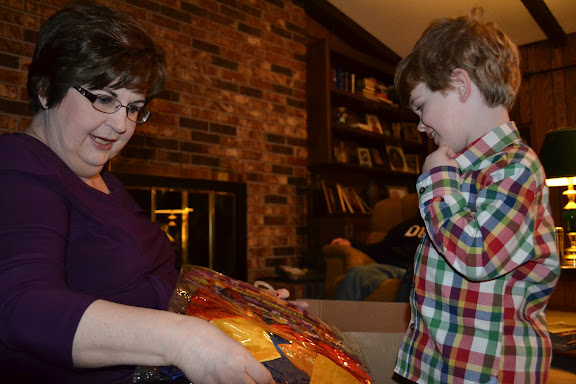
Spencer got some fun costumes, and some wind-up robots--just like on "Max and Ruby."
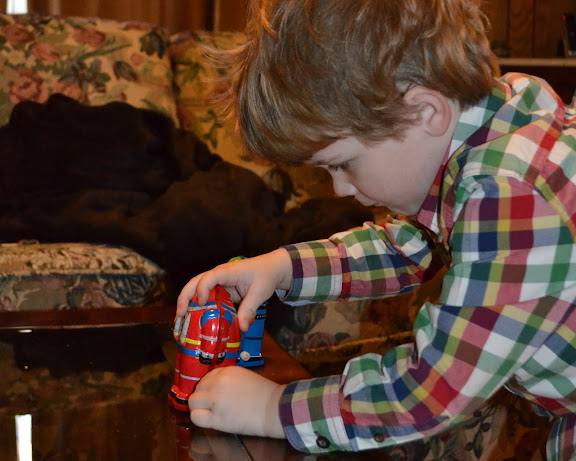
That sweet smile is directed at his new Larry-Copter.

And, I think his favorite present was the set of characters from VeggieTales' "The League of Incredible Vegetables." Just today (February 4th), he toted them to speech and occupational therapy and played with them all afternoon.
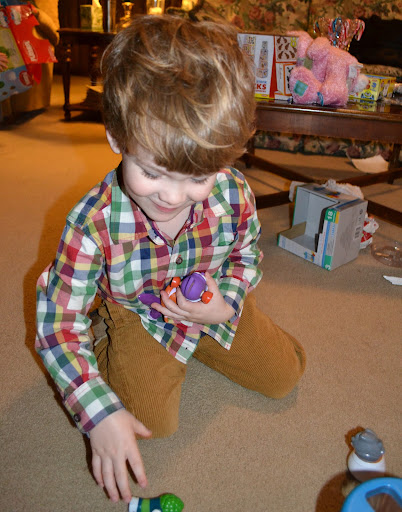

Evelyn got some stacking blocks, and a picnic basket, as well as a tea pot, and an elephant that blows balls everywhere. She was (appropriately) overwhelmed and also very interested in Spencer's new toys. She loved her teapot that sounds like it is really pouring tea. She had me pour her some tea (she says "water") over and over again. Each time she would look in the cup really confused and then try to drink water out of it. Ha! Spencer has really enjoyed showing her how to build and knock down a stacking block tower.
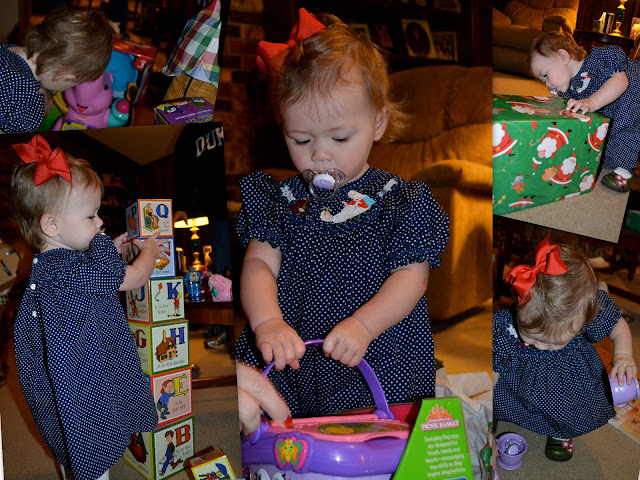
The kids were tired and still not quite back to themselves after the holidays, the ice and snow "trip" at Gigi's, and the fist stomach virus of the year; so, unfortunately, the Benton "Christmas" ended quickly. However, as far as they were concerned they have been thoroughly "Christmas-ed."
I think the picture below sums it up nicely--Knight Spencer (with Baby Jesus at his feet). Oh, to be a little boy in a knight costume!

Subscribe to:
Posts (Atom)