[Since I can't seem to stop "talking" on facebook this afternoon, it is obviously time to blog.]
I have taken care of a lot of children. And, before our lives collided with the world of therapy, evaluations, norms, and percentiles, I would have been the first to tell you loudly, convincingly, and aggressively that each child is vastly different from any other child. And, in a sense, I believe that no less now than I did then. However, in another sense, I see how that is only true in its proper nuances and setting. One of the main reasons I hear parents and doctors say that their chid does not need an evaluation for therapy "right now" is that "every child is different," and as a parent, I understand; but as a begrudging student of pediatric development, I must beg to differ.
Listen, this was me. So, if you see yourself or your doctor or your spouse or your parents in this line of reasoning please know that I'm not blasting you or any of them. But I do hope you'll read on. And maybe let yourself "go there" with me on this. If it's hard to do that, then you probably really should.
First, yes, every child is so different. Anyone who has spent any amount of time around more than one child will know this to be true. However--this is a big however--there are people who have spent their lives studying children. They've done this precisely because they are all so different. And these people, hundreds, no, thousands of them (so don't feel like you're putting all your eggs in one proverbial basket) study trends, averages, and probabilites. And, you know what they end up with? Lots of helpful information.
This information does not discount that each child is different. It is based on it. It uses averages and percentiles. It gives a broad look at what is developmentally appropriate at different ages--for all different kinds of children. You have to be careful not to tell yourself that all other kids might do it this way, but your kid, he or she is so smart or so clever or so independent or so laid back, that he or she does it differently, and that that is no need for concern.
If your baby or child really is coming up noticeably different when compared to averages, that is reason to be concerned. And here's why: the people making those evaluations and averages and percentiles are not stupid. They are not making money or getting any sort of kick back if your child is delayed or needs therapy. They work very hard to learn what type of things are cause for concern. They have written the evaluations to "catch" those babies and kids. And, look, no one wants to "catch" them to make you feel bad as a parent or to make them look bad as a child or to make your doctor look bad as a primary care doctor. They want to catch them so that they can help them.
They know that on average kids who go on to have no problems do specific things at specific age ranges--they sit, they say specific sounds, they connect interpersonally in specific ways--all, on average, around the same time developmentally. These are not indiscriminate "milestones" so that your pediatrician has something to talk to you about before your child receives specific immunizations at their "well-visit."
In America, kids go on to school around six. At six, they're supposed to be able to do certain things. If they weren't doing the things they were supposed to be doing at 18 months, it will be a problem at six. If they weren't saying the things most other kids are saying at two, it will create a problem at six. So, even if your baby or child and you are getting along quite fine, thank you, whether or not they are meeting specific milestones, there are future reasons to pay attention to them developmentally now.
So, let's discuss. If your baby is coming up fairly "different" on many general milestones, are they "fine" and "ok" and "different--in the way that every child is different?" Well, yes and no. Yes, they're fine in that they are alive and have bodily health and caring parents. They're "ok" in that they are wonderful little creatures who are most likely very loved and love others in return. And if their whole life could be done in whatever "different" way they learn or prefer to operate, there would be nothing else to worry about. There's not a lot of pediatric speech, occupational, or physical therapy in nomadic communities or in poverty stricken countries or in countries where immediate nutrition is life or death.
But, presumably, your little one will go to kindergarten and will participate in some version of a k-12 American system. If so, then it is very, very worth helping them if or when they come up short developmentally compared to their peers. [I'm not saying it's not "worth" helping all children; but I'm arguing against a "wait and see" approach that is common in America and not compatible with the way school or life is set up here.]
If, after months and months or years and years of missed or late milestones, you continue to "wait and see," you are waiting out precisely the time at which their little brains are so ready and malleable to receive help. Now, even the adult brain is neuroplastic to a degree; but we all know how quickly and amazingly babies and toddlers learn everything around them. Their brains are wired for learning NOW. What a bummer to "wait and see" through the first five years of their life if there is cause for concern. The earlier they receive therapy (if it's needed), the quicker and better the outcome.
So, to sum up, people study what's normal. Every child is different to a degree, but after that, you enter into "different" that is associated with developmental problems in the long run.
Lastly, I will tell you that unless you are a trained professional, you won't be able to tell the difference between quirky and different-enough-to-merit-a-little-intervention. You really won't. I'm as avid a researcher as you'll meet. I read scholarly articles, talked to SLP's, and I watched Evelyn very closely as her language developed. I did most everything short of going to school to be a speech pathologist. I watched her as she did some of the EXACT same "quirky" speech and language patterns and habits as her older brother Spencer who has apraxia. Honestly, it was a bit concerning. I had her evaluated, and her scores were completely within the normal range--while doing all sorts of quirky things Spencer had done at the exact same age. And, to be honest again, it was hard to rest in that evaluation. But, guess what? The evaluator was right. Her language is average (in a good way). She has no issues.
I don't mean to say that evaluators or evaluations can't sometimes be wrong. Spencer didn't qualify for speech therapy at two, and he really should have. The SLP wasn't good, and I was so sick throwing up for 20 weeks of a pregnancy that I didn't pushed her on his scores. I didn't point out other atypical patterns she may have missed. I didn't ask for a second opinion. Mistakes were made by all involved. But we were told to come back. And we did. And he was behind. So, it's not as if they just sent us on our way. The evaluation showed enough of a "delay" to flag him. That's what they're designed to do. And, in that way, it "worked."
I ramble to say, please don't decide for yourself that your child is "fine" when he or she is not within the generally accepted developmental norms.
They very well may be fine--Evelyn was. Or, they may not be fine.
My father, a general surgeon, will NOT under any circumstances diagnose a sinus infection, or a rash, or depression, or the chicken pox. If it's not in his area of expertise, he defers to someone for whom it is. Yes, he's been taught all about those things. Yes, some of those diagnoses might even seem easier than diagnoses a surgeon makes all day every day (and night), so, the assumption might be that of course he'd know about those possibly "easier" things. But that's not the way it works. A teacher is a teacher, not an occupational therapist. A pediatrician is a pediatrician, and none of the ones I've met have a degree in speech pathology or physical therapy. If they do, they probably aren't practicing as a general practitioner. A parent, no matter how many children they've had, no matter how much they know, is a parent. None of them are trained to evaluate for pediatric developmental pathology automatically by reproducing. And that's ok! It just means we all have to be humble enough to defer to another specialist--or two or eight--to get an idea about how our child is doing developmentally if there is cause for concern.
If your pediatrician is "not worried about it," that does not necessarily mean that you should not be worried about it. With all due respect, it's not the pediatrician's child. Children have parents for a reason. And that reason is they need an adult who knows them intimately and cares for them paramountly to help them navigate life. They can't do it for themselves.
Every child is different. And that's really true. And that's really great. As parents, we must work to ensure that all of the differences help them to become the person they were created to be as opposed to letting the differences dictate what will become of the child. This is not about your child being the best reader or the best runner or the best anything; this about your child getting what he or she needs to develop neurologically and physically. Timely development is imperative for healthy development.


9/10/13
Therapy Thoughts--Waiting Room Lessons
Today in the waiting room of "our" therapy clinic, I held my screaming almost-two year old and listened to one mom's story about her struggle to get her daughter proper medical care and therapy. As much as I could piece together her story, it sounded as if her daughter was in multi-system organ failure due to dehydration and malnutrition before she could convince anyone that she needed help. Evelyn screamed and kicked and this mom just went right on with her story. As soon as the therapist came out, though, she immediately stood up and went back to talk with her.
Another therapy mom-turned-friend came by and patted my shoulder as we briefly chatted before she had to run out the door to pick something up from her child's doctor for his school. We would be gone when she returned, but we confirmed we would both be there Thursday. Our new Fall schedule lends itself to a fun, thirty minute window where we look forward to overlapping in the waiting room.
A mom of four waited with her three daughters, all of whom were kind and patient as Evelyn bordered on invading their personal space. One mom I often see around town, came in with her son to pick up her little girl who'd had a great day at therapy. The mother of four and the one who came in with her son apparently know each other too. They chatted for a moment before respective therapists came out to discuss each child's progress.
Therapy mom's* can be a lot of things. Speaking for myself personally, we can be scattered, overwhelmed, frustrated, confused, guilty of over-sharing, and a little crazy. But they can also be more patient than other parents. They know all children are different and all are of infinite value. They are more able to find the bright side. An age appropriate temper tantrum because the child wants to do it herself--awesome! They are more prone to believe your story or your thoughts about your child, even if your thoughts sound unorthodox or unusual. They've been (or still are) there.
It struck me today, though, that therapy moms, possibly more than the general population of moms, need someone to listen to their story. To be honest, it was a little strange that someone would continue to tell her story while the listener's two year old decomposed. And it got me thinking how probably few real, compassionate listeners therapy moms have. I hear story after story of pediatricians who refused to give referrals for evaluations. I'm thankful that my experience has had no resemblance to that sad, reason-less trend. Grandparents can sometimes be overly confident that the child is "perfect" or overly concerned and, unfortunately, poorly equipped to communicate those concerns appropriately. Teachers can be over worked and overwhelmed to get through the day with an entire class full of children. They may not have time, energy, or resources to be a sounding board for a concerned parent. And many women don't have many actual friends to listen to whatever happens to be going on in life, including your puzzle of a two year old for whom things don't appear to be completely typical.
So, just like we all need people with whom we can freely share our or our child's "story," those of us with slightly atypical stories probably experience the need to be heard, understood, and encouraged even more acutely. And today, I noticed all of these moms doing whatever they can to help their child--at home, certainly, and at school, and at therapy--dropping everything and standing at attention when their child's therapist entered the waiting room. My kids can be screaming and running. It's possible I'm almost screaming at them to stop doing those things; but it doesn't really matter. The mom has zeroed in on her child's therapist, and she listens and explains and asks questions and hopes for answers. And while the questions and particulars might be extremely practical in nature; there is something so powerful about a good or bad report. Whether it be a yearly evaluation, a goal met, or just a really great day; the encouragement and hope it can bring is strangely powerful. And, unfortunately, the converse is true as well.
And, as all of this dawns on me; I suddenly feel sympathy for these therapists. Many of them would be considered "young" in the professional world, many of them do not have children of their own, many of them go above and beyond every day. They are doing a great, life-changing thing, but they are not trained to walk moms through the "therapy" experience. And they can't always know how well the parent is coping. I'm not sure, but I don't think they take a class on that; although I'm sure under a good clinical instructor, it could certainly be touched upon and discussed as part of good "parent communication."
Suddenly, the therapist's job is not only to be magically capable of making extremely difficult and often repetitive work fun, engaging, and productive for the child, but it also falls to them to ensure whether or not the parent is living with realistic expectations, plugging into a support network, liaising with the appropriate doctors and specialists, and finding ways of dealing with these extra stresses in a constructive manner. That's to say nothing of the parents they encounter who still need help moving into a parent role where they can learn to make caring for their child a priority. How much of that could depend on any one professional, regardless of their educational background?
So, as I left the waiting room, having watched the dynamics of the afternoon; I realized how much pressure and anticipation I can unknowingly place on the poor, unsuspecting therapists who treat my child. Of course I expect them to do their job with excellence; but I want to make a conscious decision to maintain a diversified portfolio of people with whom I can connect, vent, or find support. And, by doing so, I hope to be able to bring encouragement to the waiting room both for the therapy moms and for the therapists.
*While there are certainly therapy dads who bring their children, work with therapists, and have, no doubt, their own stories to tell, I do not make it a habit of speaking with them at great length.
Another therapy mom-turned-friend came by and patted my shoulder as we briefly chatted before she had to run out the door to pick something up from her child's doctor for his school. We would be gone when she returned, but we confirmed we would both be there Thursday. Our new Fall schedule lends itself to a fun, thirty minute window where we look forward to overlapping in the waiting room.
A mom of four waited with her three daughters, all of whom were kind and patient as Evelyn bordered on invading their personal space. One mom I often see around town, came in with her son to pick up her little girl who'd had a great day at therapy. The mother of four and the one who came in with her son apparently know each other too. They chatted for a moment before respective therapists came out to discuss each child's progress.
Therapy mom's* can be a lot of things. Speaking for myself personally, we can be scattered, overwhelmed, frustrated, confused, guilty of over-sharing, and a little crazy. But they can also be more patient than other parents. They know all children are different and all are of infinite value. They are more able to find the bright side. An age appropriate temper tantrum because the child wants to do it herself--awesome! They are more prone to believe your story or your thoughts about your child, even if your thoughts sound unorthodox or unusual. They've been (or still are) there.
It struck me today, though, that therapy moms, possibly more than the general population of moms, need someone to listen to their story. To be honest, it was a little strange that someone would continue to tell her story while the listener's two year old decomposed. And it got me thinking how probably few real, compassionate listeners therapy moms have. I hear story after story of pediatricians who refused to give referrals for evaluations. I'm thankful that my experience has had no resemblance to that sad, reason-less trend. Grandparents can sometimes be overly confident that the child is "perfect" or overly concerned and, unfortunately, poorly equipped to communicate those concerns appropriately. Teachers can be over worked and overwhelmed to get through the day with an entire class full of children. They may not have time, energy, or resources to be a sounding board for a concerned parent. And many women don't have many actual friends to listen to whatever happens to be going on in life, including your puzzle of a two year old for whom things don't appear to be completely typical.
So, just like we all need people with whom we can freely share our or our child's "story," those of us with slightly atypical stories probably experience the need to be heard, understood, and encouraged even more acutely. And today, I noticed all of these moms doing whatever they can to help their child--at home, certainly, and at school, and at therapy--dropping everything and standing at attention when their child's therapist entered the waiting room. My kids can be screaming and running. It's possible I'm almost screaming at them to stop doing those things; but it doesn't really matter. The mom has zeroed in on her child's therapist, and she listens and explains and asks questions and hopes for answers. And while the questions and particulars might be extremely practical in nature; there is something so powerful about a good or bad report. Whether it be a yearly evaluation, a goal met, or just a really great day; the encouragement and hope it can bring is strangely powerful. And, unfortunately, the converse is true as well.
And, as all of this dawns on me; I suddenly feel sympathy for these therapists. Many of them would be considered "young" in the professional world, many of them do not have children of their own, many of them go above and beyond every day. They are doing a great, life-changing thing, but they are not trained to walk moms through the "therapy" experience. And they can't always know how well the parent is coping. I'm not sure, but I don't think they take a class on that; although I'm sure under a good clinical instructor, it could certainly be touched upon and discussed as part of good "parent communication."
Suddenly, the therapist's job is not only to be magically capable of making extremely difficult and often repetitive work fun, engaging, and productive for the child, but it also falls to them to ensure whether or not the parent is living with realistic expectations, plugging into a support network, liaising with the appropriate doctors and specialists, and finding ways of dealing with these extra stresses in a constructive manner. That's to say nothing of the parents they encounter who still need help moving into a parent role where they can learn to make caring for their child a priority. How much of that could depend on any one professional, regardless of their educational background?
So, as I left the waiting room, having watched the dynamics of the afternoon; I realized how much pressure and anticipation I can unknowingly place on the poor, unsuspecting therapists who treat my child. Of course I expect them to do their job with excellence; but I want to make a conscious decision to maintain a diversified portfolio of people with whom I can connect, vent, or find support. And, by doing so, I hope to be able to bring encouragement to the waiting room both for the therapy moms and for the therapists.
*While there are certainly therapy dads who bring their children, work with therapists, and have, no doubt, their own stories to tell, I do not make it a habit of speaking with them at great length.
9/6/13
Surprises
Children surprise you. They surprise you by surprising you. When you most expect a specific, predetermined outcome, they change up the ending on you. The ending you've watched eight thousand times. This is at once comforting and terrifying. It's comforting when they surprise you by growing up a year's worth seemingly over night. It's terrifying that you never know what they are capable of right under the surface of who they are day in and day out. That you don't expect great things from them because you've become accustomed to some other not as great things. How sad that you would spend their precious toddler and preschool years so focused on all the crazy of the day to day that you forget to equip, encourage, and instill for who they will become as opposed to who they currently are.
It's easy to forget because they have to eat--regularly! Many also do eventually learn to talk, clearly and constantly--even the ones with apraxia. In this country, at least, there's also the expected outings of childhood that are pretty much a requirement. Luckily, that's one of the things I thoroughly enjoy about raising my kidlets; but it sure puts a damper on house keeping....or cooking....or functioning in really any other capacity; there's a lot of day to day to juggle around, let alone attempting to visionarily raise them.
It's easy to forget because there are so many people whose job it appears is to encourage you to focus on the here and now. Well-meaning, loving people who each have their own very specific area of training, expertise, world-view, and sometimes, if we can all agree to call a spade a spade, opinions, about where, when, why, how, how often, to what extent, and with whom your child should be, go, learn, do, create, and grow. As a mom who considers her family to be her career as well as her calling, it's a lot to take in. If it's your job to do right by them, then, of course you are not so arrogant as to think there are not others who know more about some things than you. So, you research and listen and question and, sometimes, almost forget.
It's easy to forget the people they will be, the people you've not yet had the pleasure of meeting. It's easy to forget no one else will be responsible for the outcome to the degree that you will be. It's easy to forget how you'd hoped this whole thing would go. Your own ideas and values, that you'd dreamed of living out in your calling to these small, becoming creatures who call you "Mommy." The people they will be exist positively in so much as I'm creating in them love, kindness, courage, and capability now. Keeping those people-in-the-making in mind helps tune out the noise.
In the end, they'll surprise themselves too. They have no way of knowing what is happening each and every day under their own precious curls. They know songs, stories, family, and teachers. They know more than I'm proud to admit of "Max or Ruby," "Veggie Tales," "Daniel Tiger," and "Psalty." But they don't know that someday, in retrospect, the surprises might form a fairly clear trajectory; that today, yesterday, and last week are not all that is going on. Characters are being formed; synapses are being made; love is being shared. And, I'm hopeful that those things are preparing us all for great surprises.
It's easy to forget because they have to eat--regularly! Many also do eventually learn to talk, clearly and constantly--even the ones with apraxia. In this country, at least, there's also the expected outings of childhood that are pretty much a requirement. Luckily, that's one of the things I thoroughly enjoy about raising my kidlets; but it sure puts a damper on house keeping....or cooking....or functioning in really any other capacity; there's a lot of day to day to juggle around, let alone attempting to visionarily raise them.
It's easy to forget because there are so many people whose job it appears is to encourage you to focus on the here and now. Well-meaning, loving people who each have their own very specific area of training, expertise, world-view, and sometimes, if we can all agree to call a spade a spade, opinions, about where, when, why, how, how often, to what extent, and with whom your child should be, go, learn, do, create, and grow. As a mom who considers her family to be her career as well as her calling, it's a lot to take in. If it's your job to do right by them, then, of course you are not so arrogant as to think there are not others who know more about some things than you. So, you research and listen and question and, sometimes, almost forget.
It's easy to forget the people they will be, the people you've not yet had the pleasure of meeting. It's easy to forget no one else will be responsible for the outcome to the degree that you will be. It's easy to forget how you'd hoped this whole thing would go. Your own ideas and values, that you'd dreamed of living out in your calling to these small, becoming creatures who call you "Mommy." The people they will be exist positively in so much as I'm creating in them love, kindness, courage, and capability now. Keeping those people-in-the-making in mind helps tune out the noise.
In the end, they'll surprise themselves too. They have no way of knowing what is happening each and every day under their own precious curls. They know songs, stories, family, and teachers. They know more than I'm proud to admit of "Max or Ruby," "Veggie Tales," "Daniel Tiger," and "Psalty." But they don't know that someday, in retrospect, the surprises might form a fairly clear trajectory; that today, yesterday, and last week are not all that is going on. Characters are being formed; synapses are being made; love is being shared. And, I'm hopeful that those things are preparing us all for great surprises.
6/16/13
All About Spencer and Evelyn's Daddy
Interview with Spencer
Father's Day 2013
How old is your daddy? I don't know. Four?
What color is your daddy's hair? Black.
What color are your daddy's eyes? I don't know. He's a worker. He's at work.
What kind of clothes does your daddy like to wear? His blue shirt and all the other clothes.
What does your daddy like to eat? Peanut butter banana sandwich.
Do you see him eat that? Uh huh. A few weeks ago.
Your daddy is smart because he knows everything!
Your daddy works hard at work, at his office.
Where is that? At church.
What does Daddy do at work? He has a horse to ride. He lays on a pillow and takes a nap. Is that correct?
If you could give your daddy anything, what would it be? Me!
What is your daddy's name? Jonathan
What is his last name? Kelley
Where does your daddy like to go? All over the whole wide world--and he can do anything!
For fun, he likes to play! What do you guys play with? With my bristle blocks.
My favorite thing to do with my dad is play Daddy tag.
I love my dad because I play with him!
Interview with Evelyn
Father's Day 2012
How old is your daddy? Daddy! [Giggling]
What color is your daddy's hair? Daddy! [Giggling]
What color are your daddy's eyes? [Laughing hysterically]
What kind of clothes does Daddy wear? [Laughing hysterically]
Do you love Daddy? No! [Squealing and laughing]
Spencer: Mommy, I think you better ask Evie again.
5/21/13
Evelyn Rose As A 20 Month Old
Evie Roo, you still love to help, especially when it means we are leaving the house. You love to get dressed, get bags packed, and when I tell Spencer to get his shoes on, you often go get them before he does and start putting them on for him. He's starting to appreciate this set up, and smiles delightedly and tells you "Thanks, Evie!" Y'all are quite a pair. You love to hi-ya!, sword fight, play chase, and build forts with him, but you also love you baby dolls and you try to diaper them, change their clothes, wrap them up in blankets, and take care of them.

At night, you love to be tucked in with a collection of goodies, including your pacifiers, blanket, pillow, cup, two of Spencer's stuffed dog Natalie got him from Ikea, your Owl from Nana, your Violet dog who plays night time songs, and your baby doll along with its cup, bottle, and paci. When I put you in your crib, you lay your head down on your pillow, and then you want to be covered up with a blanket. You sometimes sleep in your big girl bed with no problem, but we're still working on getting you to sleep all night long, so we haven't switched you over yet.

Spencer finally convinced us to let you guys play in the hose in May. It was not very hot yet, and you were freezing; but you so wanted to be involved. Even when you were shivering and turning purple, you would not let me wrap you up and carry you inside. When you saw me taking your picture, you said, "Cheese" with Spencer.


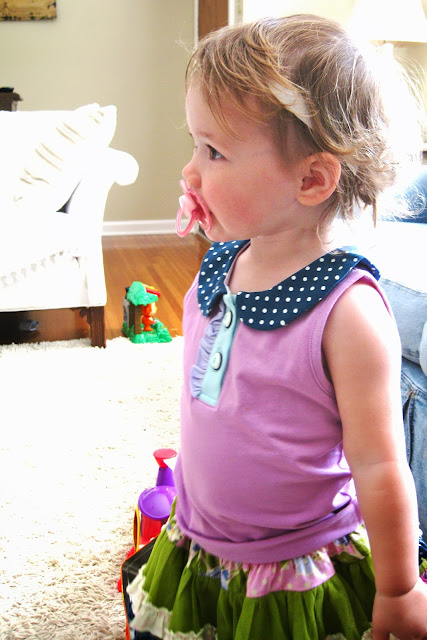
You already really enjoy accessorizing. The picture above is an example of your current style. After I get you dressed, you tell me, "Bow?" and we find you a bow. I have to be really quick or you start picking out all sort of clippies and head bands, along with paci clips (which you think are an accessory), and once you've decided you want to wear something specific, we usually just go with it. You're not easily swayed. You don't like to wear a pony tail very much. Sometimes if we're busy enough you'll leave it in, but as soon as we get home or you get still in your car seat, you pull it out.

You miss Spencer when he is at gone, but you do like playing with his toys without harassment.




At night, you love to be tucked in with a collection of goodies, including your pacifiers, blanket, pillow, cup, two of Spencer's stuffed dog Natalie got him from Ikea, your Owl from Nana, your Violet dog who plays night time songs, and your baby doll along with its cup, bottle, and paci. When I put you in your crib, you lay your head down on your pillow, and then you want to be covered up with a blanket. You sometimes sleep in your big girl bed with no problem, but we're still working on getting you to sleep all night long, so we haven't switched you over yet.
Spencer finally convinced us to let you guys play in the hose in May. It was not very hot yet, and you were freezing; but you so wanted to be involved. Even when you were shivering and turning purple, you would not let me wrap you up and carry you inside. When you saw me taking your picture, you said, "Cheese" with Spencer.
You already really enjoy accessorizing. The picture above is an example of your current style. After I get you dressed, you tell me, "Bow?" and we find you a bow. I have to be really quick or you start picking out all sort of clippies and head bands, along with paci clips (which you think are an accessory), and once you've decided you want to wear something specific, we usually just go with it. You're not easily swayed. You don't like to wear a pony tail very much. Sometimes if we're busy enough you'll leave it in, but as soon as we get home or you get still in your car seat, you pull it out.
You miss Spencer when he is at gone, but you do like playing with his toys without harassment.
You still LOVE Barney, and you really singing songs and dancing or doing the motions. You love "Mr. Sun," "Skin-A-Marinkee Dinky Dink," "Itsy Bitsy Spider," the "ABC Song," "Wheels On the Bus," and "If All the Rain Drops." Anything you can do motions to, you really love. You like it when I sing a song and let you fill in the last word to each phrase. I pause and you sing the missing word while smiling really big. You do not like for games, songs, or movies to be over.
When I got home from a quick trip to Savannah, you ran up to me and said, "Hold me!" After that you have had an expressive language explosion. It's so fun to hear your little voice sound like a big girl. Some of your favorite phrases are "Spencer, aaaaaare yoooooouuu?" "T'Mon, Da--ee, sit here." And "'Mon, Ma-ee" along with "Clean up."
You did so well with your Dad, your Aunt Natalie, and our church friend Holly while I was gone. I missed you so much, but I was so proud of you. They said you didn't fuss at all at Sunday School, or with Nat or Holly. You're growing up so quickly.
Also, waiting for me to get home from Savannah was the stomach virus. You and Spencer both had it the night I arrived, but Daddy and I managed to miss this one.
Subscribe to:
Posts (Atom)